 Recently I undertook a one-off concert with my band The Good Hurt where we themed the visual side of the show on the movie The Planet of the Apes. By that I mean we dressed up in white boiler suits and had a French VJ (Emmanuelle) broadcast and remix the original movie onto our clothes and faces while we performed. We had a few guests that day (Brother Ghazi, The What Supreme, Annette) and luckily they all came along and wore white too. I also played acoustic guitar rather than electric to give it that final postnuclear back to the basics feel;)
 The concert was held in a little cafe place called the Koffee Pot in Manchester (just off Oldham Road) with a bring your own booze policy. The event was part of the Futuresonic 2007 festival and as the festival has a big emphasis on context, technology and video it became the excuse I needed to finally 'get down' with my obsession with Planet of the Apes' or more specifically - the thread between ape and man. I only need the slightest of pushes in this direction to get momentum and have often thought about the social truisms that might have sprung up round a shared fire by 'primitives' that went later with recorded records to become species behaviours and societies. Those bonobos bang the bongos too you know.....
 In the film three astronauts survive a crash landing on an earth-like planet. Their last chance of contacting home disappearing under the waves. The first and last scenes bookend the film brilliantly and both, in essence, have a very similar theme of the frailty of man and his technology. The opening showing a wonderful piece of technology, a spaceship, sinking into an ocean while the last scene shows something of a similar nature - one of the most iconic statues made by man (Venus de Milo aside) shown half buried in the sand and revealing to the astronauts that they are in fact on planet earth albeit 2000 years into the future. It's a hell of an endin
 g. The movie was adapted by Michael wilson and Rod Seling from the novel La Planete des singes. Rod Serling is better known for his work on the TV shorts The Twilight Zone and it was his genius in adding the last scene which did not exist in the book - eventually envied by the original novelist for the weight it adds to the story. Those two scenes are very powerful and encapsulate the film in a simple arc. The rise and fall of man and the cyclic nature of technology and more primatively....dominance.
MOVIECLIP HORSEBACK MANHUNT
I love this clip of the gorillas hunting down the primitive mute humans and the accidentally stranded astronauts horribly caught up with the hunt. The use of the camera by the gorillas in the scene after the hunt is priceless too as they stand with their feet on the human spoils and laugh. It's proper chilling. The Gorillas clad in leather military outfits on horseback hunt down humans using tools such as nets and guns to a soundtrack of alarmed brass instruments and strings. 2000 years in the future and apes have domesticated the horse and replicated one of man greatest achievements, along with guns and cameras.

The 'mastering' of the horse was so fundamental in getting the really 'big wheels' of our recent globalism started. Historians and archaelogists have suggested the domestication of horses by humans first took place in the Ukraine at approximately 4000BC. The use of horses by this early Indo-European culture shows in the rapid spread of the Kurgan culture and the ease with which it dominated over Pre Indo European cultures. Communications, speed and force were all on the side of cultures who had dominated the horse. Persian Emperors commanded their empire more coherently than their earlier counterparts of Assyrian and earlier still Mesopotamian cultures. Responding to an uprising or a rebellion was much easier with the use of horses to firstly hear about the uprising and secondly to send troops on horseback to quell it.
The humans on this future version of earth are dumb creatures and easily dominated by the apes - used for sport and labour. They are taken back to ape city and they are subjected to experiments. Charlton Heston, who plays the lead man, is subjected to court rulings by the variety of lead monkeys and women. The logic against man and his barbarity, or apparent barbarity as the humans see it, is argued over by the chimps, organutans and gorillas in a complex social discourse not too unsimilar to our own.
 In a Science article, Carel van Schaik reports observing geographic variations in orang-utan behaviour that could be considered culture. In her study, van Schaik outlined the characteristics of culture into four sub-sections:
- 1. labels, "where food preferences or predator recognition are socially induced,"
- 2. signals, socially transmitted vocalizations or displays,
- 3. skills, innovations like tool use that are learned by the group, and
- 4. symbols, "probably derived from signal variants that became membership badges of the social unit or population."
Not all anthropologists agree with this but I do as a punter. Whales haven't been rearranging sea algae in to multiple alphabets and concocting large dialogues between them selves about the existential sense of whale and monkeys are still primitive and habitat focussed in their signage to one another. Today, for the most part, only humans have all four elements of 'culture', but chimpanzees and, now, orangutans have been observed to exhibit the first three.
"The presence in orangutans of humanlike skill (material) culture pushes back its origin in the hominoid lineage to about 14 million years ago, when the orangutan and African ape clades last shared a common ancestor, rather than to the common ancestor of chimpanzees and humans," says van Schaik.

In the flip world of planet of the Apes there is a fully developed set of symbols that operate among the chimps, orang-utans and gorillas. Symbols on archtiecture, on clothing and externalisation of self is everywhere. Not only do apes rule and act in a rich manner they have a class system encompassing the main families of ape.
The gorilla police, military, and labourers;
The orang-utan administrators, theologians, and politicians;
The chimpanzee scientists, intellectuals and workers.
 Each of the ape groups has a wonderful style of clothing that identifies them and their social place/rank. I've even checked out the possibility of getting clothing as used in the movie but it's limited to ex Hollywood stock at very high prices on E-bay and crap generic monkey masks masquerading as legitimate film related merchandise. It's a blend of leather and cloth and the colours are so deliciously 1960's that any one of the outfits are on my top 10 bits of clothing to get. Chimps are green, Orang-utans are orange and the Gorillas are purple.
Humans, who cannot talk, are considered to be "less than ape" and as such are treated like cattle for sport and experimentation. The arrival of the astronauts who can talk throws ape society into disarray and the majority of the apes, especially the gorilla's, want to eradicate the humans...some chimps however take pity on the humans and seek to know more about the phenomenon and to  know more fully where and 'when' they came from.
Many animals have been observed using tools: Dolphins use sponges when fishing, crows use sticks to forage for insects in dead wood, capuchin monkeys use stones to break open nuts.Researchers can learn about chimpanzee "culture" by tracking nut-cracking behavior. Cracking nuts is no easy feat, and it can take a chimpanzee up to seven years to learn how to do it correctly. The technology is passed from generation to generation and diffuses across populations. Knowledge is a virus, language is a virus as real as any forest fire or ocean swelling.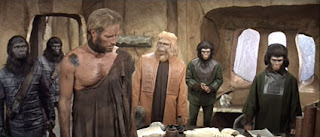 Zaius, the Orang-utan and eminent scientist soon discovers Taylor's ability to talk and puts him on trial when he tries to escape. After the trial, he is taken to see Dr. Zaius, who threatens to emasculate and lobotomize him if he doesn't tell the "truth" about where he came from. But Cornelius and Zira (the leading chimp synpathisers) execute a plan to free Taylor.
They flee to the Forbidden Zone - not a million miles away from the idea of a Twilight Zone - a place where anything could happen and you must expect the unexpected. As a destination - you know that the Forbidden Zone is going to be the shiz - the name makes it such desirable as location. The forbidden zones of our own society can often educate and not always for the good. Apes of today have a sense of the forbidden in social protocol with regards food, shelter, and reproduction rights but they are more really rules - no great lore and story associated with it. In the movie Cornelius, the chimpanzee, aracheologist and historian had a year ago visited the Forbidden Zone and found human artifacts there and they return to find out the series of events that led to man losing earth through nuclear war. The story of mans fall and apes rise is played out to them in the forbidden zone and the final sign shown that he has travelled to the future and witness to a horrible fate. That statue of liberty covered up to her chest in sand.
The concepts in the film aren't exactly that oblique and the apes become surrogates for examining human behaviour - not only the treatment of animals by humans but the dynamic between humans themselves. The backdrop for the movie being made in the 1968 was the cold war as examined by the long haired hippies.
The dramatic climax near the end of the movie when Cornelius reads directly from the Sacred Scrolls at the now-captured Dr. Zaius' request : Beware the beast man, for he is the Devil's pawn. Alone among God's primates, he kills for sport or lust or greed. Yea, he will murder his brother to possess his brother's land. Let him not breed in great numbers, for he will make a desert of his home and yours. Shun him; drive him back into his jungle lair, for he is the harbinger of death.
MOVIECLIP of DR ZAIUS SPEECH
The advent of tool making has always been a double edged sword as far as 'progress' goes. It is thought that shards or flakes from the use of stones to crack open nuts were the first flints or knives and knives can be used for cutting food or taking out your neighbour. Nuclear power has this duality too - cheap and simple power production intertwined with the horrible bomb.
 The movie was recently 're imagined' by Tim Burton however it just doesn't' seem to hold the same gravitas with me. The original with it's stark sets and simplistic approach is much more Shakespearian (helped by Roddy McDowall - arguably the lead chimp). The production in it's limited budget and techniques is almosyt theatre-like and emphasises the drama and the philosophical questions at stake much better than the overblown remake.
The original reminds me of a great book I read by James Morrow called 'This Is the Way The World Ends' where the dead hold a trial in the Antarctic of the six remaining living and those directly and indirectly responsible for the nuclear war that ravaged the earth.
You have been warmed....

Drongomala


 Posts


